Facts About Osprey That Visit Colonial Beach
What is an Osprey?
Osprey are majestic birds of prey that frequent coastal areas. Including areas with rivers and lakes that are highly populated with fish, since their main diet consists of fish. Osprey are also commonly referred to as Fish Hawks, Sea Hawks or River Hawks.
Osprey are large skilled hunters. Their size is close to that of the Bald Eagle but Eagles are on average larger than Osprey.

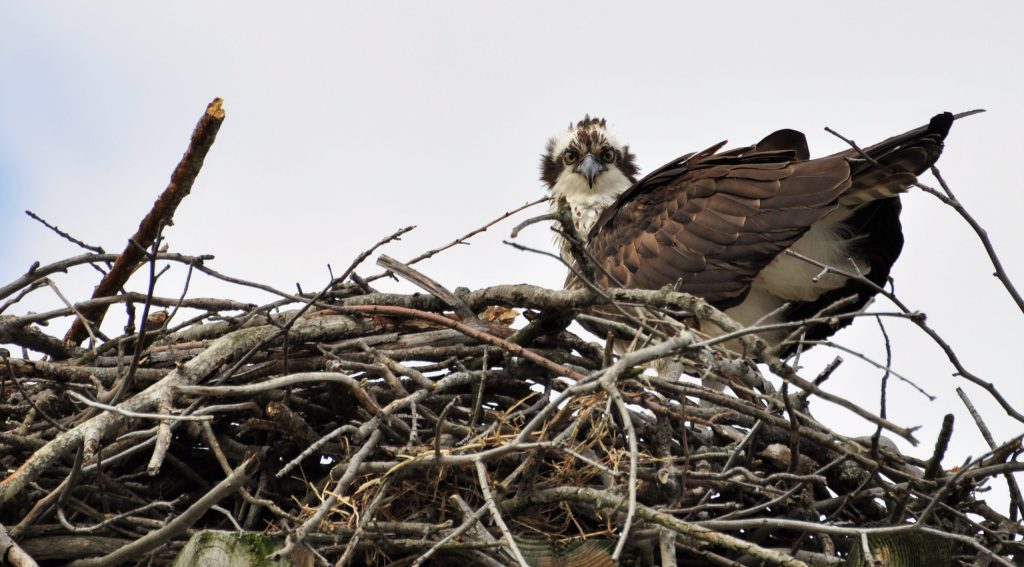
The size of a full grown Osprey can reach up to 24 inches in length from the tip of their beak to the end of their tail. Its wingspan can reach up to 71 inches. An Ospreys wings and back are dark brown from its neck to its tail feathers. The underside of the Osprey wing is mostly whitish gray with some dark across the center and on the wing tips. The Osprey head is mostly white with a brown band that stretches just behind the beak over and under its eye and stretching back to the nape. The breast of an Osprey is white with occasional streaks of brown.
Osprey Have Evolved To Hunt Fish
The Ospreys beak is hooked and its talons are uniquely adapted to catch fish. Osprey have three front facing toes and one rear facing toe with large talons for grasping its prey. However, unlike other birds of prey, (except the owl) Osprey have a unique ability to turn one of its front facing toes backwards-facing. They also have sharp spicules on their toes. These features make grasping wiggly fish much easier and helps make Osprey one of the most successful fishing birds in a locality.
Despite being an excellent fish hunter, not every attempt ends with a catch and there are rare occasions where Osprey have to fight to keep their prey as this video from Smithsonian Channel shows.
On the rare occasion that an Osprey does drop its prey, it never goes back for it. The fallen fish, if not lucky enough to return to the water unharmed, becomes fair game for other fish, water birds, or animals.
Although 98 percent of an Ospreys diet is fish, they also will eat other small birds, frogs, turtles, mammals, reptiles such as snakes or other small invertebrates.
Migration
The Osprey in Colonial Beach will begin returning to their nests between late February and early March. They head south for the winter in late October and early November. Making way for a small population of Bald Eagles who winter here in Colonial Beach.
Nesting

As soon as Osprey return home to Colonial Beach they begin working to build, rebuild or revamp their traditional nesting spots. Osprey will return to the same nest every year. If something prevents them from nesting where they usually do, such as platform destruction or tree removal, they will find the nearest suitable location they can find to build again. This includes hard boat canopies, sailing masts or a nearby high structure like a cell tower. Nests can span as much as 6 feet and weigh up to 298 pounds. This can cause a problem if built on a private structure or boat and a fire hazard if built on an electric pole or tower.
Nesting materials range from large tree branches and driftwood. Soft items include grasses, leaves, moss, the odd material found laying around like plastic, cloth strips or paper bags. From the water they’ll often pull flotsam and jetsam. Osprey are opportunists when it comes to preparing a soft bed for their babies.
Here is an awesome video of a pair of Osprey building a nest and mating in preparation for the seasons reproductive cycle.
Osprey eggs have an incubation period from 36 to 45 days. Depending on how far apart the eggs were laid this can result in a pair sitting on the eggs from one and a half, to two months. Usually three eggs are laid, one in considerable advance of the other two, which ensures the first one to hatch is larger and older than its siblings. This ensures at least one chick will survive in times of crisis such as food shortage, unexpected nest damage or the occasional raccoon raid.
It takes about 2 months for chicks to grow strong enough and learn to fly, their nestling period is about 50 to 55 days. After learning to fly, Osprey will remain in the nest with their parents for about another two months taking advantage of their parents for protection.
Here is the same family as the hatchlings grow, learn to eat, practice for, and take their first flight.
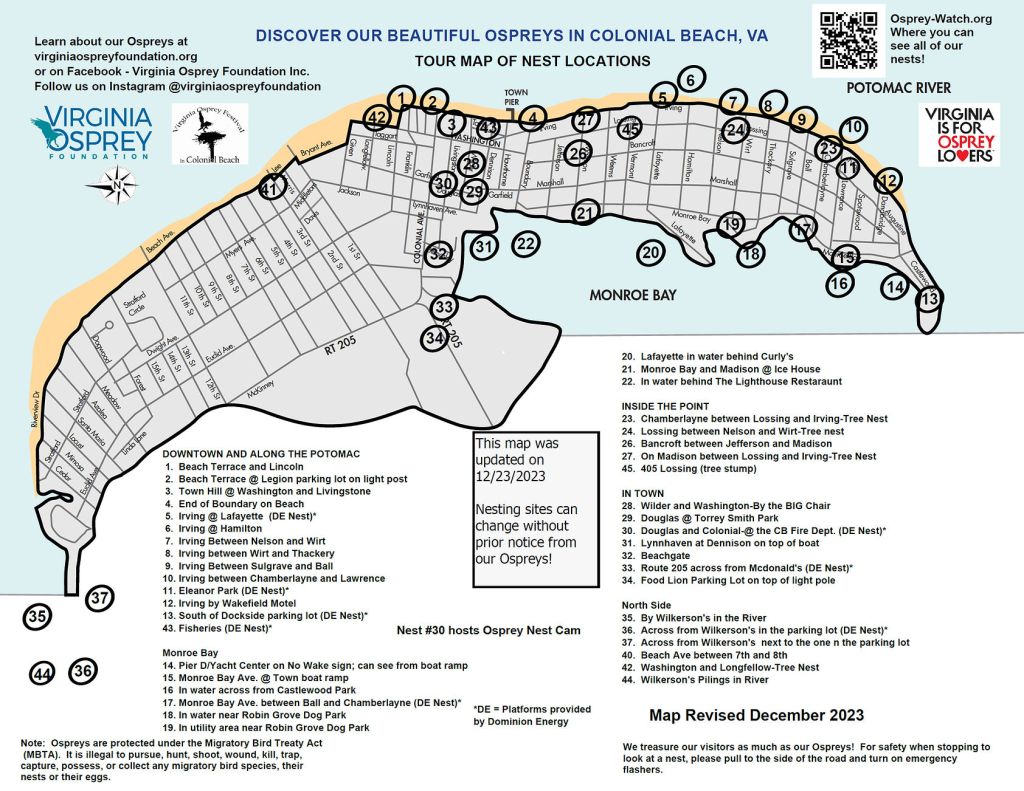
Colonial Beach is home to a growing number of Osprey pairs, and there is a dedicated group of volunteers and bird watchers who monitor and keep track of these mating pairs. Here is a map of current nests in Colonial Beach and you can get more information by going to this website.
Live Cam of Osprey Nest In Colonial Beach
Osprey News
A Gals gotta eat! Some of the links here on this site may be affiliate links. Which means I may earn a commission if you click on any of them and/or purchase from those links. However my commission will not cost you any extra.
 Tour Colonial Beach
